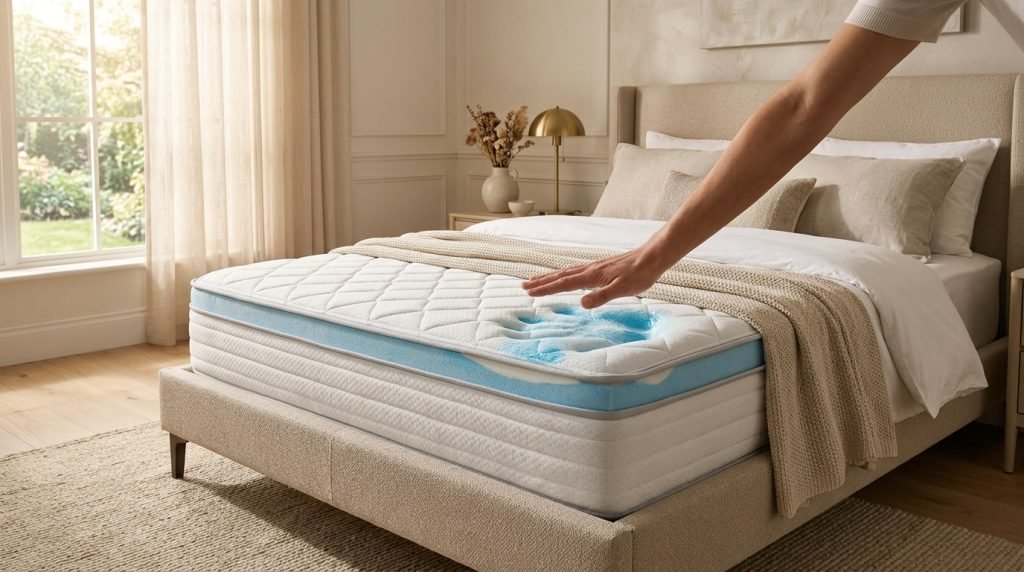
- 1. How Memory Foam Creates Weightless Comfort
- 2. The Heat Challenge: Solving Ahmedabad’s Warm Summers
- 3. Traditional vs. Cool Gel-Infused Memory Foam
- 4. Ideal Density and Thickness Guide
- 5. Who Benefits Most from a Memory Foam Mattress?
- 6. The SleepZen Memory Foam Range
- 7. Frequently Asked Questions
Memory foam was originally developed by NASA in the 1960s to cushion astronauts during extreme gravitational takeoff forces. Today, it is revered as the ultimate material for pressure-free, contouring comfort. But when buying a memory foam mattress in Ahmedabad, one question always arises: Will it sleep too hot?
At SleepZen, we specialize in next-generation Cool-Gel Open-Cell Memory Foam designed specifically to provide the signature hug of memory foam while keeping you cool and refreshed throughout Ahmedabad’s warmest nights.
1. How Memory Foam Creates Weightless Comfort
Memory foam is viscoelastic—it responds to both your body weight and body temperature. When you lie down, it gently softens beneath your heaviest pressure points (shoulders, ribs, and hips), distributing your weight seamlessly and giving you the sensation of floating.
The result? Virtually zero pressure points, minimized tossing and turning, and dramatically deeper, uninterrupted REM cycles.
2. The Heat Challenge: Solving Ahmedabad’s Warm Summers
Old-fashioned memory foam had a dense, closed-cell molecular structure that trapped body heat. In Ahmedabad’s dry, hot climate where summer night temperatures hover in the 30s, standard memory foam can lead to sweaty, uncomfortable sleep.
The SleepZen Cooling Solution: We use advanced Cooling Gel Infusion. Microscopic gel particles absorb and dissipate thermal energy away from your body, while an open-cell porous matrix allows air to circulate with every movement.
3. Traditional vs. Cool Gel-Infused Memory Foam
| Feature | Traditional Memory Foam | SleepZen Cool-Gel Memory Foam |
|---|---|---|
| Breathability | Low airflow, retains body heat | High airflow open-cell structure |
| Temperature Feel | Warm to hot over 4–5 hours | Thermally neutral and cool to the touch |
| Response Time | Sluggish recovery when changing positions | Faster adaptive rebound |
| Motion Transfer | Excellent motion isolation | Near-perfect zero motion transfer |
4. Ideal Density and Thickness Guide
- Memory Foam Comfort Layer: Should be between 1.5 to 3 inches thick. Anything less provides insufficient contouring; anything more can make you feel “stuck.”
- Support Base Layer: Must be at least 4 to 6 inches of high-resilience (HR) support foam to prevent bottoming out.
- Total Mattress Thickness: 6 inches for light to average sleepers; 8 inches for couples or luxury comfort.
5. Who Benefits Most from a Memory Foam Mattress?
- Side Sleepers: Cushions sharp pelvic and shoulder points, preventing morning arm numbness.
- Couples: Absorbs vibrations so one partner turning or getting out of bed does not disturb the other.
- Light Sleepers: Silent operation with zero squeaks or creaks compared to traditional spring beds.
6. The SleepZen Memory Foam Range
Order online at SleepZen and enjoy free doorstep delivery, inside-room setup, and full warranty support across all areas of Ahmedabad. Contact our team at +91 78745 33459 to find your perfect firmness.
7. Frequently Asked Questions
Does a memory foam mattress sag quickly?
High-density memory foam (50D+) backed by high-resilience support foam retains its shape for 8–10 years. Low-density cheap foams, however, may sag within 1–2 years.